
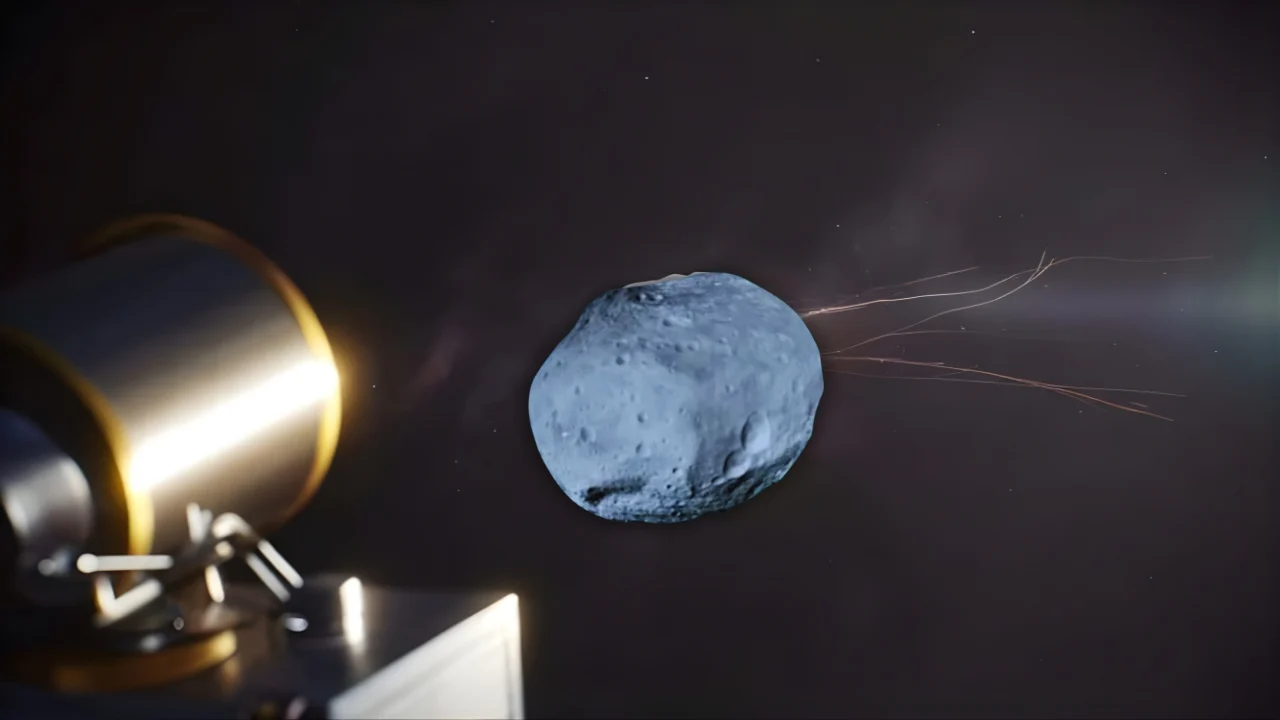
For the first time in history, twelve NASA spacecraft and telescopes have joined forces to study an interstellar comet, a visitor from another star system. The object, officially named 3I/ATLAS, was discovered on July 1, 2025, by the NASA-funded ATLAS telescope in Chile, marking just the third known interstellar object ever observed passing through our solar system.
The newly released images from eight different missions represent a major scientific milestone. From Mars orbiters to deep-space telescopes, each observation contributes a unique perspective on the composition, structure, and behavior of this cosmic wanderer.
“Every image, every dataset gives us another piece of the puzzle,” said Dr. Elena Rodriguez, planetary scientist at NASA’s Jet Propulsion Laboratory. “3I/ATLAS is a window into how other planetary systems form and possibly, how ours once looked billions of years ago.”
What Makes 3I/ATLAS So Unique?
Unlike comets that originate in the outer reaches of our solar system, 3I/ATLAS was born around another star. It carries the chemical fingerprints of its alien home system, materials that predate our Sun.
| Key Facts About 3I/ATLAS | Details |
|---|---|
| Discovery Date | July 1, 2025 |
| Discovered By | NASA-funded ATLAS Telescope (Chile) |
| Type | Interstellar comet |
| Closest Approach to Earth | December 19, 2025 (170 million miles) |
| Trajectory | Hyperbolic, exiting the solar system |
| Previous Interstellar Visitors | Oumuamua (2017), 2I/Borisov (2019) |
This makes 3I/ATLAS only the third known interstellar traveler, after 2017’s mysterious cigar-shaped Oumuamua and 2019’s comet 2I/Borisov.
Observations from Mars: The Closest Look Yet
Three NASA missions near Mars captured the comet from closer than any other vantage point.
| Mission | Observation Details |
|---|---|
| Mars Reconnaissance Orbiter (MRO) | Snapped detailed imagery from just 19 million miles away, revealing the comet’s bright coma and faint tail. |
| MAVEN (Mars Atmosphere and Volatile Evolution) | Used ultraviolet sensors to study the gas composition, providing insights into 3I/ATLAS’s volatile materials. |
| Perseverance Rover | Captured a faint glow from the Martian surface, marking the first time a comet from another star has been imaged from another planet’s ground. |
“These observations from Mars are groundbreaking,” said Dr. Susan Lee, astrophysicist with NASA’s Planetary Science Division. “We’re seeing a comet from another star system through the eyes of robots on another world, that’s never happened before.”
Sun-Watching Missions Track the Hidden Comet
As 3I/ATLAS passed behind the Sun from Earth’s perspective, several of NASA’s heliophysics missions continued tracking it.
- STEREO observed the comet from Sept. 11 to Oct. 2, following its movement through the inner solar system.
- SOHO, a NASA–ESA collaboration, monitored the comet between Oct. 15 and 26, tracking how solar radiation affected its tail.
- PUNCH, NASA’s newest heliophysics mission, captured some of the first close-up images of the comet’s tail structure between Sept. 20 and Oct. 3.
This marks the first time solar-observing spacecraft have intentionally targeted an interstellar object, a significant milestone for planetary and solar research.
Asteroid Missions Join the Effort
Even NASA’s active asteroid missions turned their instruments toward 3I/ATLAS to help refine its orbit and study its material composition.
| Mission | Observation Date | Distance from 3I/ATLAS | Purpose |
|---|---|---|---|
| Psyche | Sept. 8–9, 2025 | 33 million miles | Captured four observations to refine the comet’s path. |
| Lucy | Sept. 16, 2025 | 240 million miles | Recorded multiple exposures, stacked for detailed analysis of the coma and tail. |
“These missions weren’t designed to study comets, let alone interstellar ones,” noted Dr. Marcus O’Donnell, lead investigator for the Lucy mission. “But their adaptability shows how NASA’s fleet can pivot to take advantage of cosmic surprises.”
Deep Space Telescopes Deliver Unmatched Detail
NASA’s most powerful observatories also joined the campaign.
- James Webb Space Telescope (JWST) captured infrared spectra, analyzing the comet’s ice and dust composition.
- Hubble Space Telescope (HST) provided visible-light imagery to compare surface brightness and tail morphology.
- SPHEREx, designed to map the entire sky in infrared, observed 3I/ATLAS in August 2025, identifying several rare chemical compounds in its dust cloud.
“These complementary datasets let us compare the interstellar material of 3I/ATLAS to our own comets,” explained Dr. Priya Natarajan, NASA astrophysics fellow. “It’s like holding up two ancient artifacts from different worlds and studying how each one was built.”
What’s Next for Comet 3I/ATLAS?
The comet will make its closest approach to Earth on December 19, 2025, at a safe distance of 170 million miles, roughly twice the distance between Earth and the Sun.
After that, it will continue its trajectory through the outer solar system, passing near Jupiter’s orbit by spring 2026 before disappearing into deep space forever.
NASA’s global network of spacecraft will continue monitoring 3I/ATLAS through its exit, ensuring every particle of data is captured.
“This is a visitor we’ll only see once in our lifetimes,” said Dr. Emily Zhao, NASA astrophysicist. “Every byte of data we collect could change how we understand the birth of planets and the chemistry of distant solar systems.”
Why the 3I/ATLAS Mission Matters?
Studying an interstellar comet isn’t just about curiosity; it’s about tracing our cosmic origins. By comparing 3I/ATLAS’s materials to those found in our own comets, scientists can test theories about how planets form, evolve, and migrate across galaxies.
It’s also a major demonstration of NASA’s inter-agency collaboration, with planetary, astrophysics, and heliophysics teams all contributing.
“This is a triumph of coordination,” said Dr. Richard Lewis, director of NASA’s Science Mission Directorate. “We’re turning the entire solar system into one giant observatory.”
FAQs
What is comet 3I/ATLAS?
3I/ATLAS is the third confirmed interstellar object to enter our solar system, discovered in July 2025. It originated from another star system.
How is NASA studying it?
Twelve spacecraft and telescopes, including Webb, Hubble, Psyche, Lucy, SOHO, STEREO, MAVEN, and MRO, are collectively observing the comet.
Why is this important?
3I/ATLAS carries material from another solar system, giving scientists clues about how planets and comets form elsewhere in the galaxy.
When will it be closest to Earth?
The comet reaches its closest approach on December 19, 2025, at 170 million miles away.
Will it return?
No. 3I/ATLAS is traveling too fast to remain captured by the Sun’s gravity. It will exit our solar system permanently after 2026.